Oppa Dramabiz Work
A diagnostic and operating system for your health, wealth, and capacity. It surfaces hidden failures early, tracks stability over time, and points you to the lever that needs attention.
Get Notified at Launch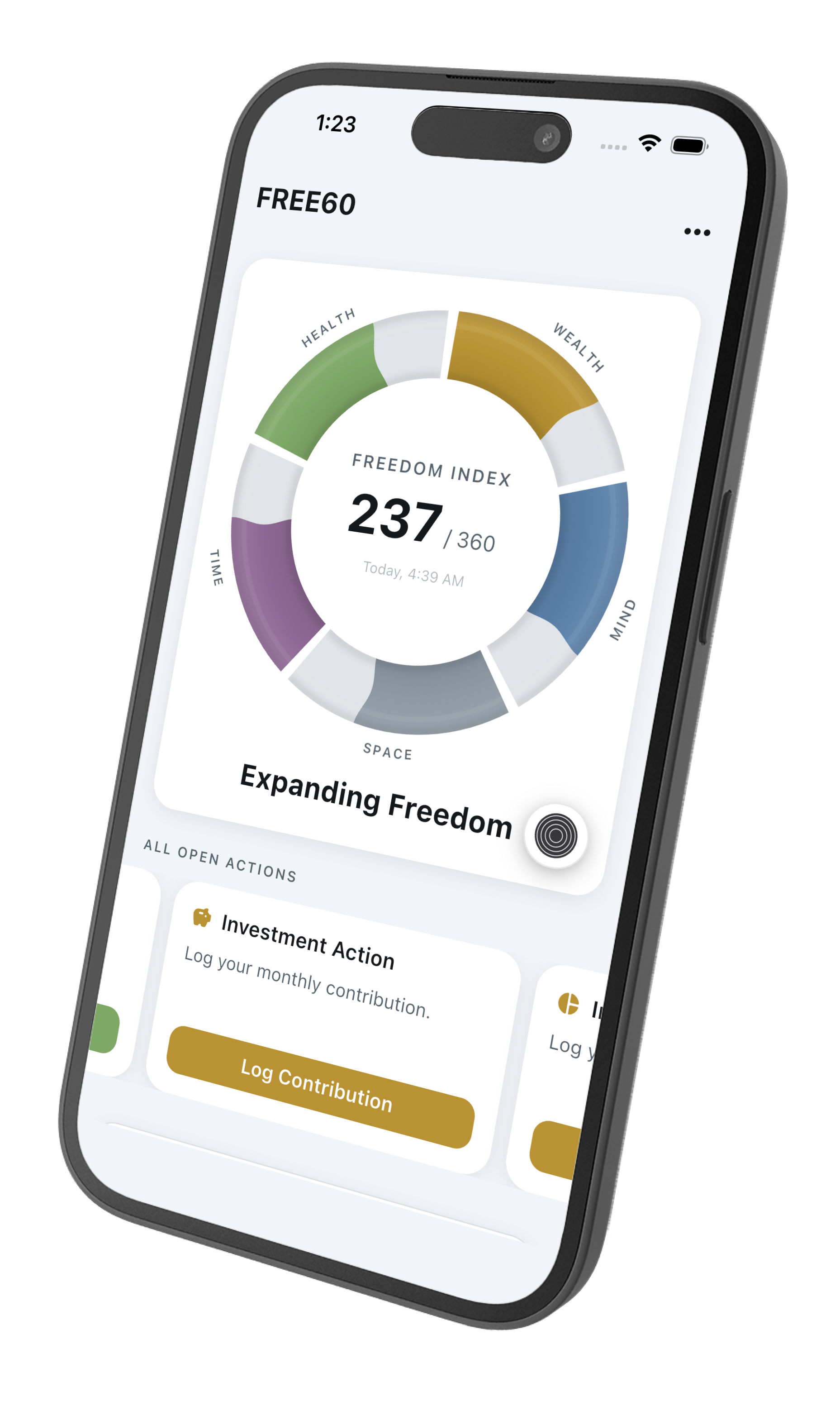
A diagnostic and operating system for your health, wealth, and capacity. It surfaces hidden failures early, tracks stability over time, and points you to the lever that needs attention.
Get Notified at Launch
Who it's for
Not broken. Not failing. Competent, analytical, self-directed. Running at maybe 60% of what you're capable of. You can't explain why.
You sleep 7 hours and wake up tired.
You earn well and don't know where the money went.
You start things and don't finish them. Not from laziness. From fragmentation.
You own a wearable you stopped using.
You have a plan for the week. By Tuesday it's gone.
You read productivity advice you already know. The issue isn't knowledge.
None of these feel catastrophic. That's exactly why they compound.
Audience labor and fandom economies Fans are not passive consumers; they are active investors. Organized streaming parties, coordinated social-media pushes, and bulk purchases of physical goods amplify a drama’s success. This "audience labor" is often unpaid but indispensable. Producers and platforms knowingly harness it: social hooks in narratives, collectible items timed with broadcast windows, and interactive marketing encourage fans to produce free promotion. The result is a participatory economy where fandom shapes not just revenue but creative choices—writers and producers monitor fan reactions in near real time and sometimes even pivot storylines to maintain momentum.
Ethics and representation: beyond romance As K-dramas reach wider audiences, questions about representation and ethics have grown louder. How do portrayals of gender, class, and mental health translate internationally? Do romanticized depictions of unequal power dynamics—boss-subordinate relationships, obsessive pursuit framed as courtship—normalize harmful behavior? Producers face increasing scrutiny from global viewers who bring different cultural expectations. A mature industry response would pair creative ambition with responsibility: more nuanced character writing, consulting on sensitive topics, and transparent handling of off-screen labor conditions. oppa dramabiz work
But the industrial realities complicate artistry. Tight production schedules, overnight rewrites, and the commercial imperative to accommodate product placement and sponsorships often lead to narrative shortcuts—character motivations flattened in service of a viral moment, subplots truncated to protect pacing, and endings engineered more for social-media debate than for thematic closure. That tension shapes what we love about K-dramas: they are efficient emotional machines, finely tuned to produce shareable feelings even when they sacrifice subtlety. Audience labor and fandom economies Fans are not
Labor and precarity: who pays the price? While the "oppa" star and the platform executives receive most public attention, the production workforce bears much of the cost of rapid expansion. Long hours, temporary contracts, and thin margins for crew, writers, and junior staff mirror global patterns in creative industries. Moreover, the rise of fandom-driven commerce can place psychological burdens on actors, with intense scrutiny of personal behavior affecting casting and careers. Agencies manage these risks, but the power imbalance between talent and corporate decision-makers leaves many workers exposed to sudden shifts—canceled projects, contract disputes, or image-driven blacklisting. Producers and platforms knowingly harness it: social hooks
Transnational flows also complicate content decisions. Writers and producers now make creative choices with multiple audiences in mind: domestic viewers, diaspora communities, and global fandoms with differing expectations about pacing, subtext, and representation. This can lead to creative compromises—storylines that minimize culturally specific nuance to maximize cross-border clarity—or it can produce hybridized works that blend local texture with universal emotional beats. Either way, the drama business increasingly operates as an export industry, with government incentives, trade show diplomacy, and soft-power calculus baked into funding decisions.
In recent years the term "oppa"—a Korean honorific used by younger women for older men—has migrated beyond casual conversation into a shorthand for a broader cultural phenomenon: the global appetite for Korean popular culture, and the ecosystems that produce, market, and monetize it. "Oppa dramabiz work" sits at the intersection of three overlapping forces: the creative labor of K-drama production, the star-making machinery that elevates male leads into multi-platform "oppa" brands, and the commercial strategies—both domestic and international—that turn serialized storytelling into sustained business growth. This column examines how those forces interact, who wins and loses, and what the future might hold.
The business architecture: platform power and transnational flows Streaming platforms changed the game. Global services buying K-dramas—either licensing hits or financing originals—have altered risk models. Domestic broadcasters still matter in Korea for prestige and award-season placement, but international platforms provide scale and predictable revenue. Their algorithms reward watchability and retention, which reinforces formulaic tendencies but also budgets more ambitious projects that might previously have been impossible.
The experience
The architecture is deep. The experience is not. Every level gives you a clean read. Every level lets you go deeper, but only if you want to.
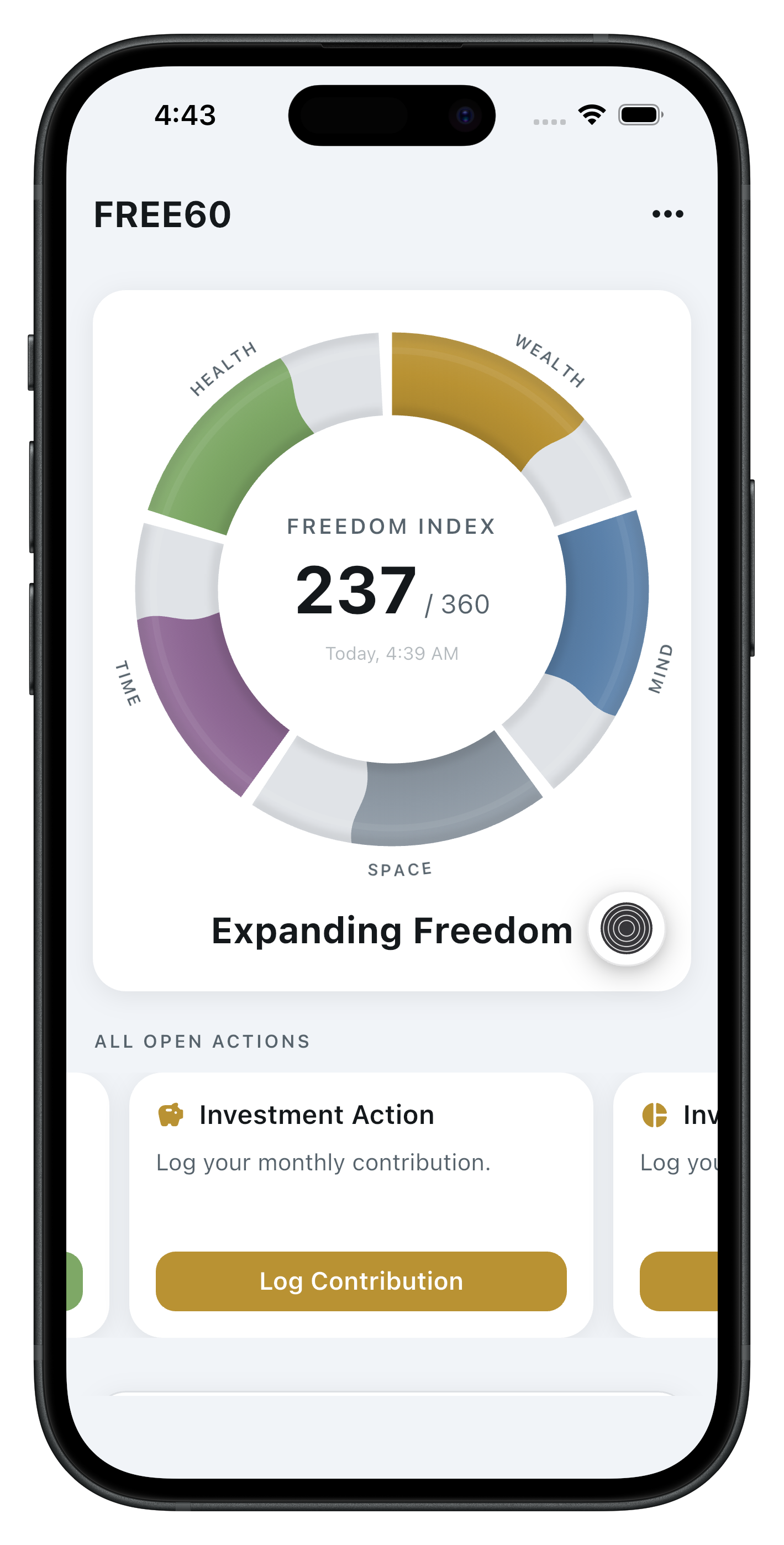
One ring. Three dimensions. One number. You open the app and immediately know where things stand.
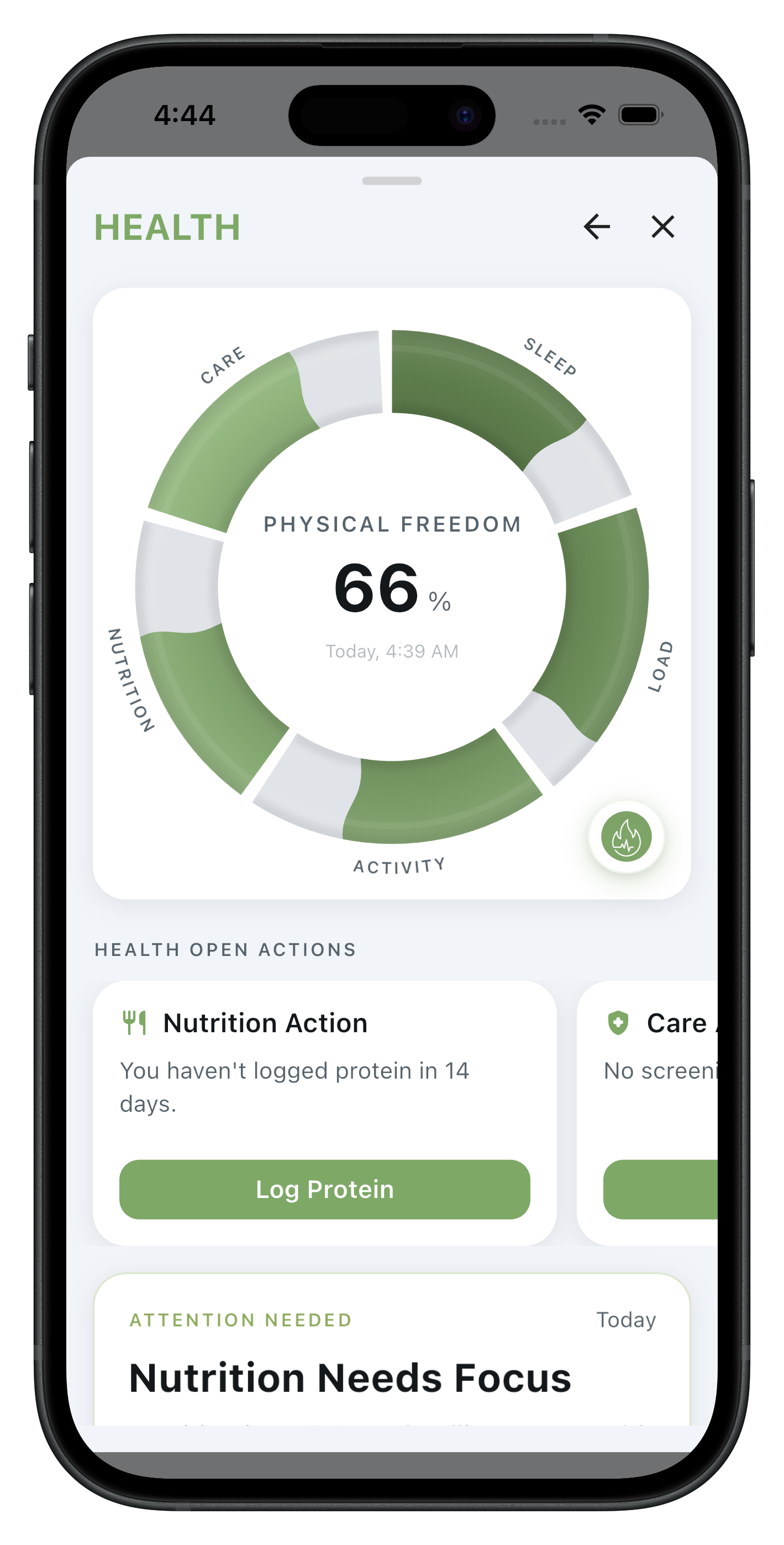
See the lever breakdown. Signal groups surface what needs attention across each lever. Spot what's moving and what's stable.
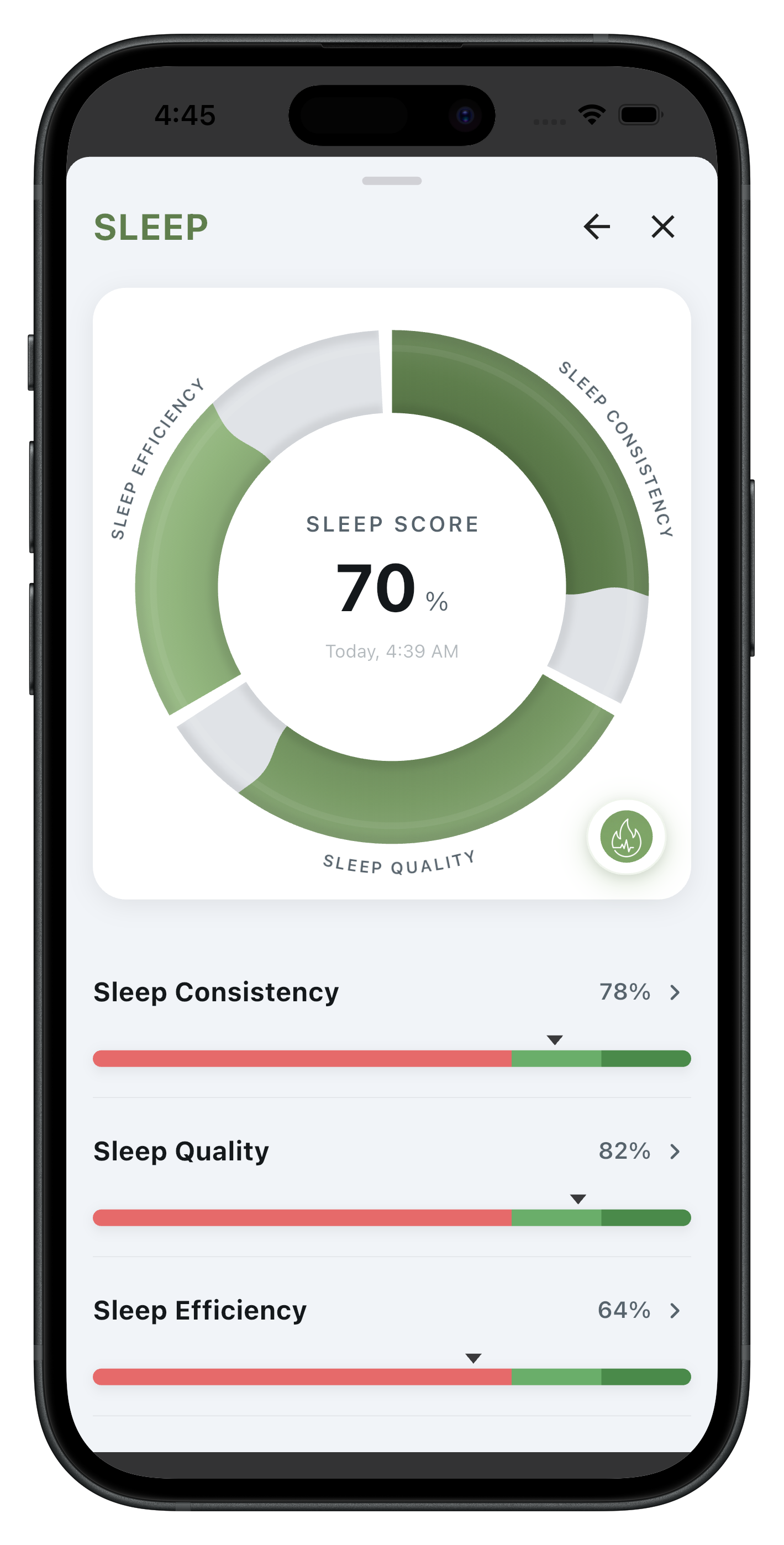
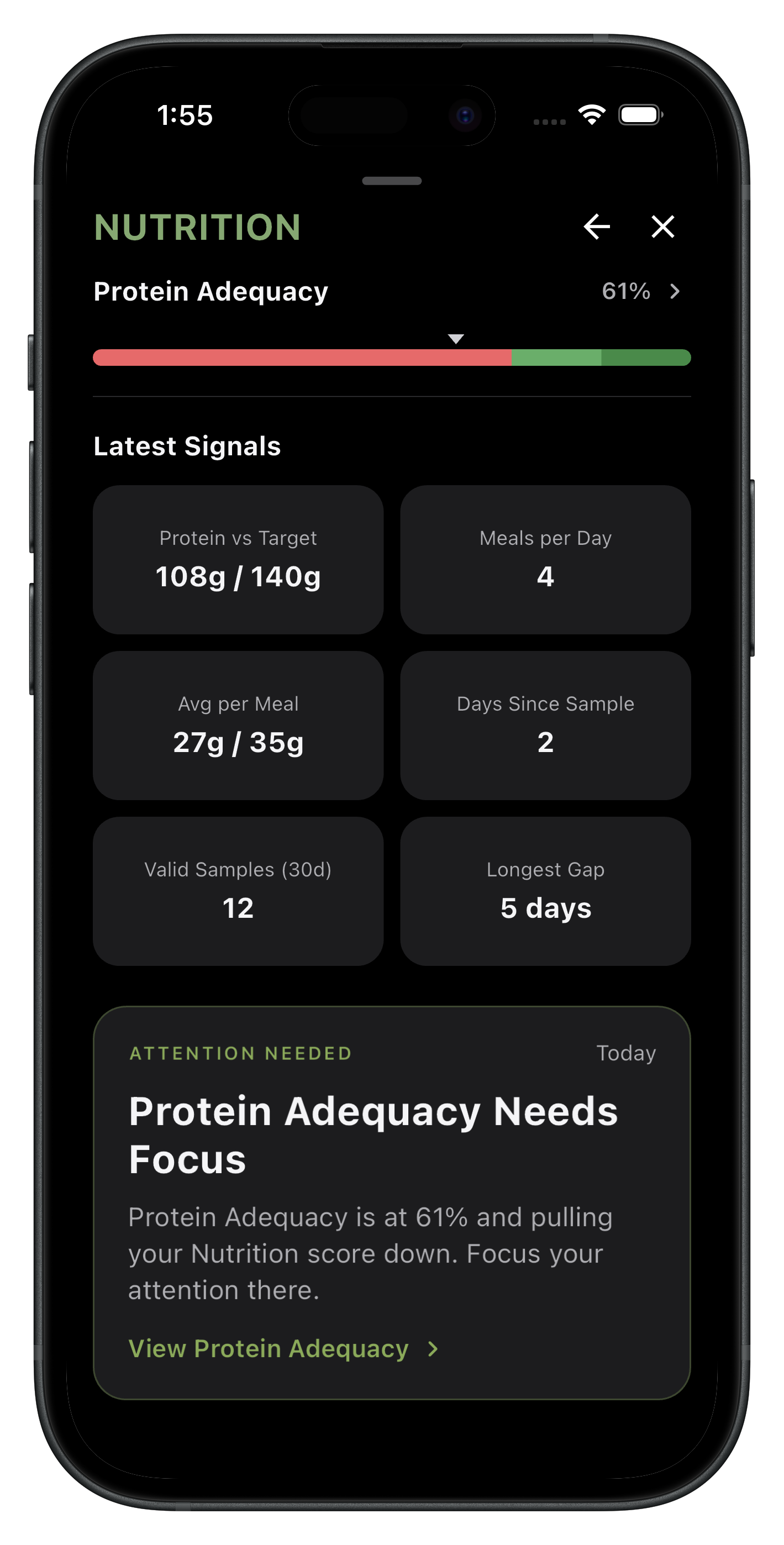
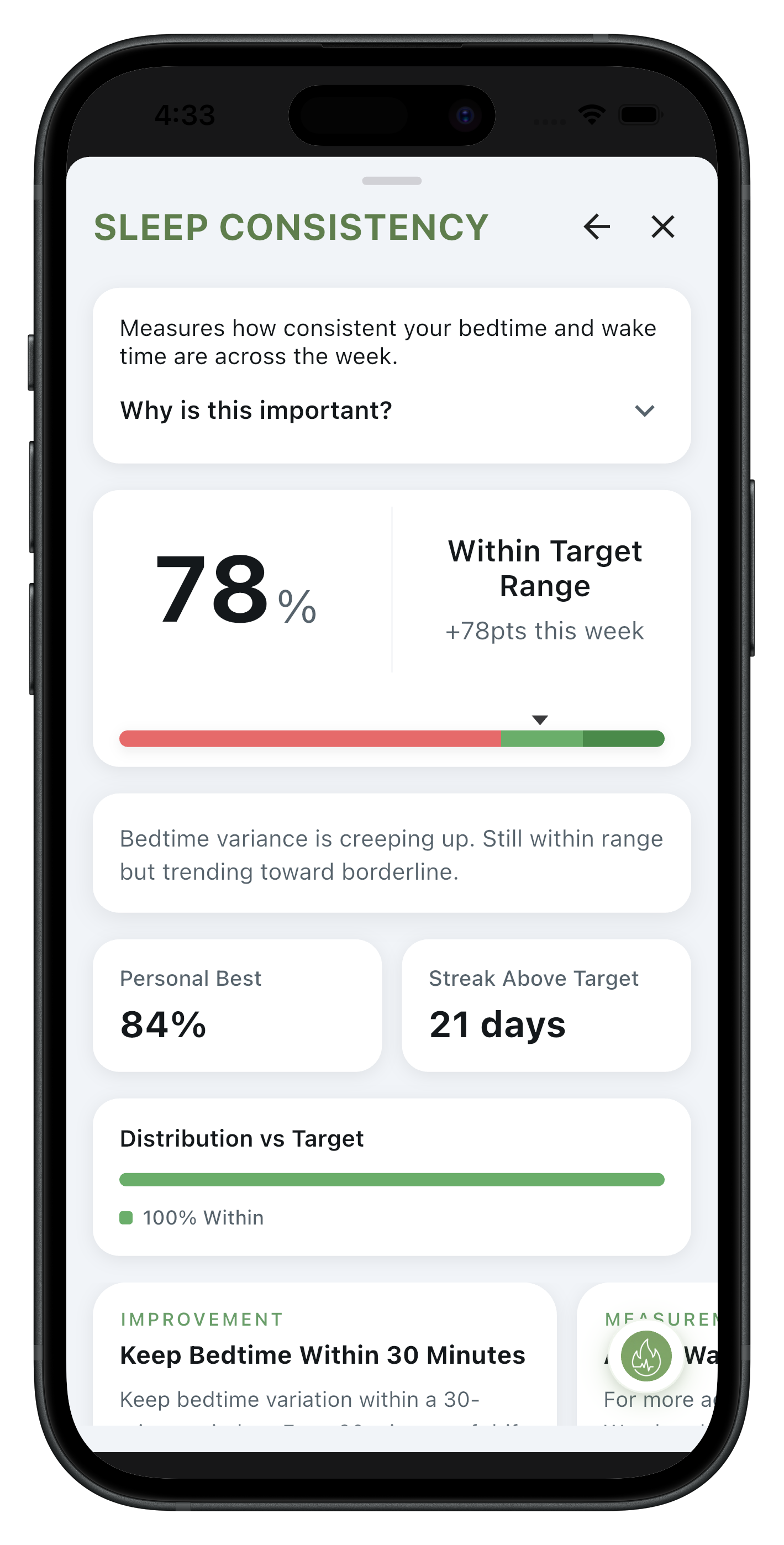
Indicator scores with range bars. Historical trend. See exactly which indicator is failing and by how much.
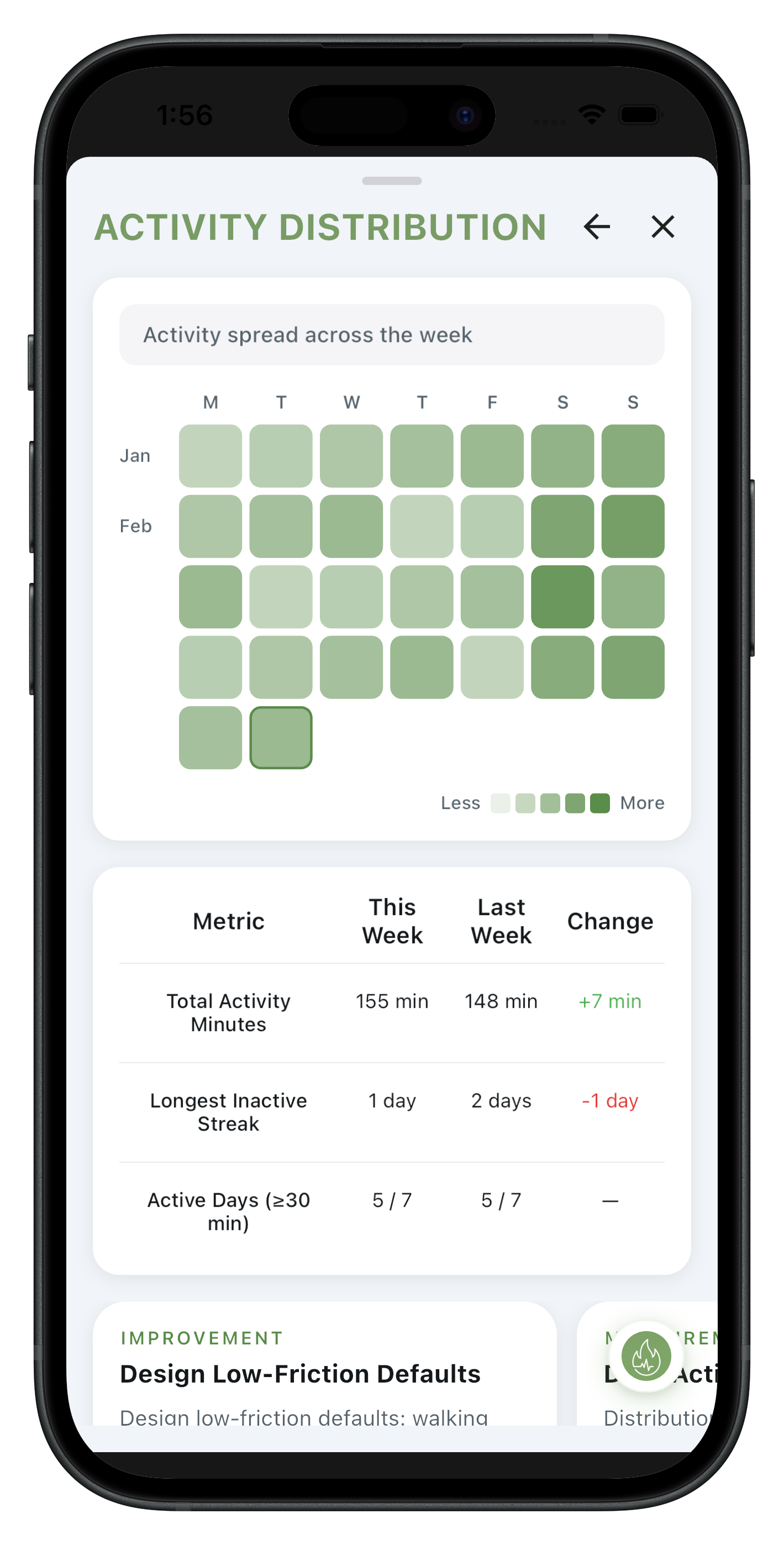
Full chart. Latest signals. Insight. Educational context. What to investigate next.
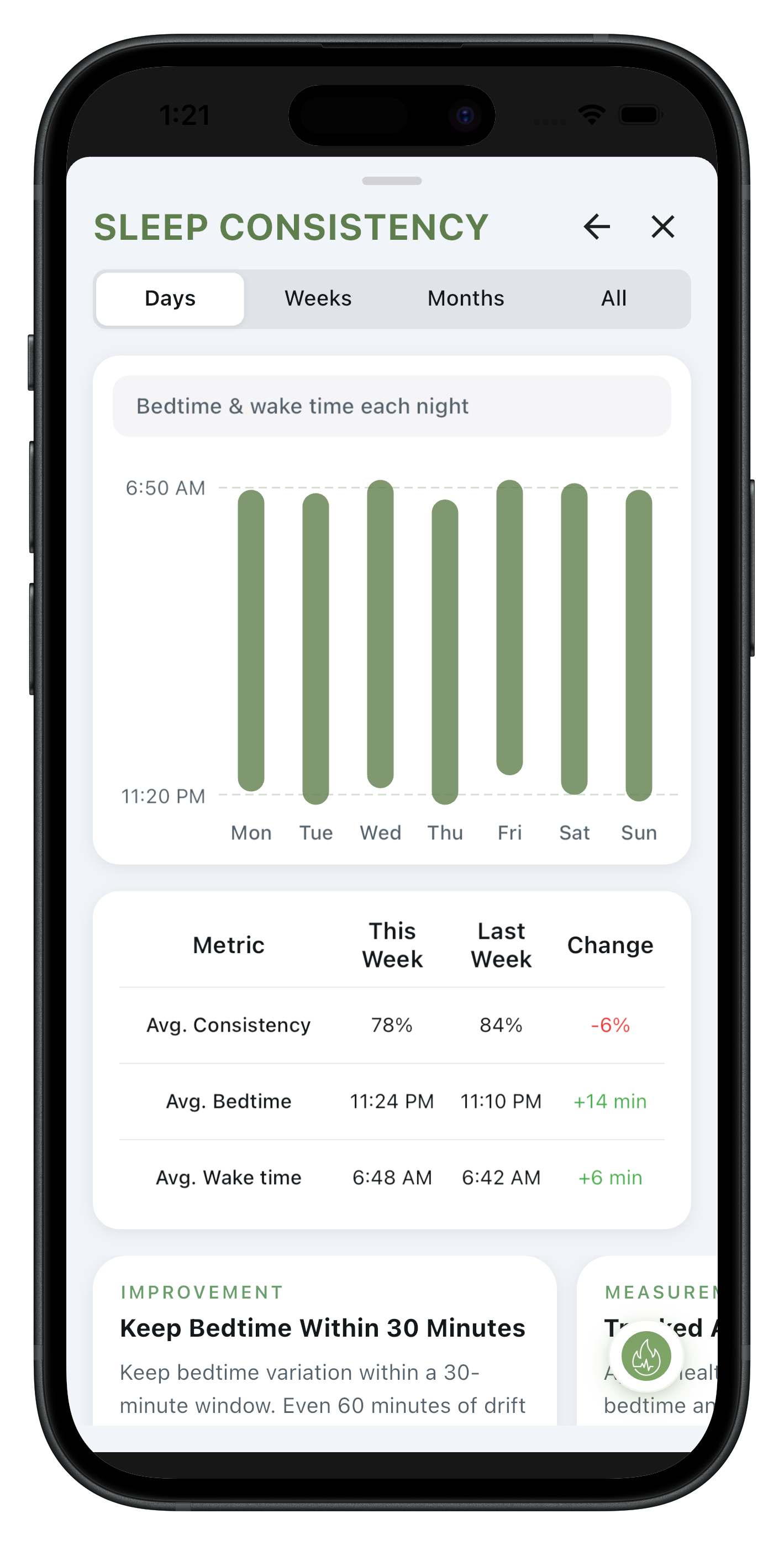
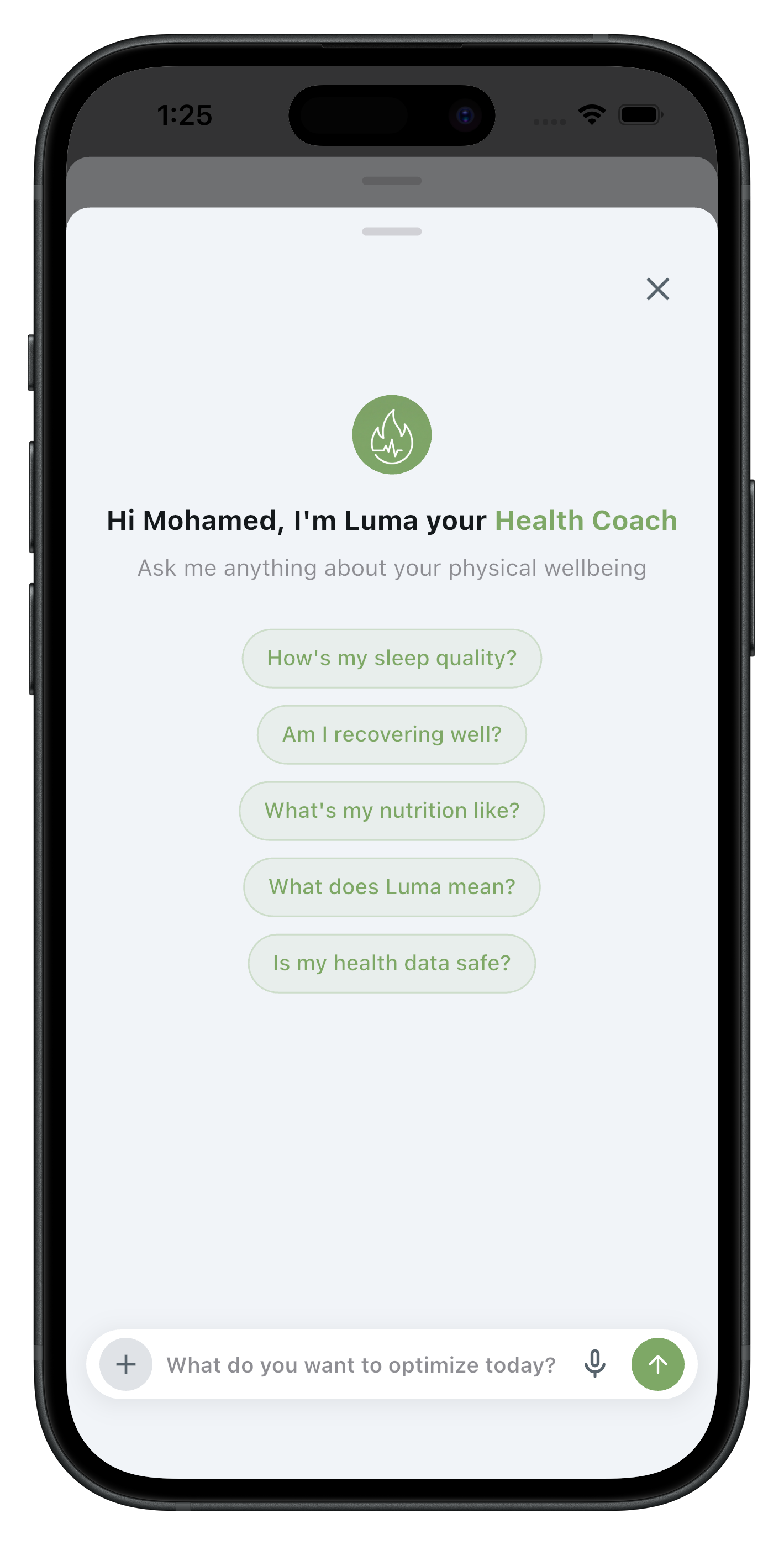
At every level, automated insight cards tell you what changed, why it matters, and what to do. "Attention Needed" flags degradation. "Bridge the Gap" shows cascading failure. "Improvement" gives specific actions from your data. Your AI guide adds a deeper layer: ask anything, get answers grounded in your own scores.
Built-in intelligence
Not generic advice. Each guide is trained on the FREE60 system: what is being measured, what patterns mean, and how problems in one area can affect another. When Luma says your Sleep is pulling your load tolerance down, it's reading your actual score history. When Halo sees a pattern across dimensions, it's seeing your data, not a template.
Tap or click a guide button to flip the card and read more.
Reads across all three dimensions to surface connections and cascades no single lens can see. Available from the home screen.
Back
Reads your sleep, load, and recovery scores. Flags physical drift before you feel it. Tells you what's pulling your Health score down and what to do first.
Back
Reads your financial levers against each other. Surfaces risk before it forces a decision. Scores your Wealth trend and tells you what's degrading.
Back
Maps the gap between what you said matters and what your schedule actually reflects. Detects attention fragmentation, priority drift, and rhythm collapse before they compound.
Back* Pro only. Your raw health data never leaves your device. AI chat uses aggregated scores only.
Launching June 17, 2026

iOS and Android. Apple Health and Health Connect.
All three dimensions production-grade: Health, Wealth, and Capacity. 15 levers, 26 indicators, all charts, all insights, four AI guides.
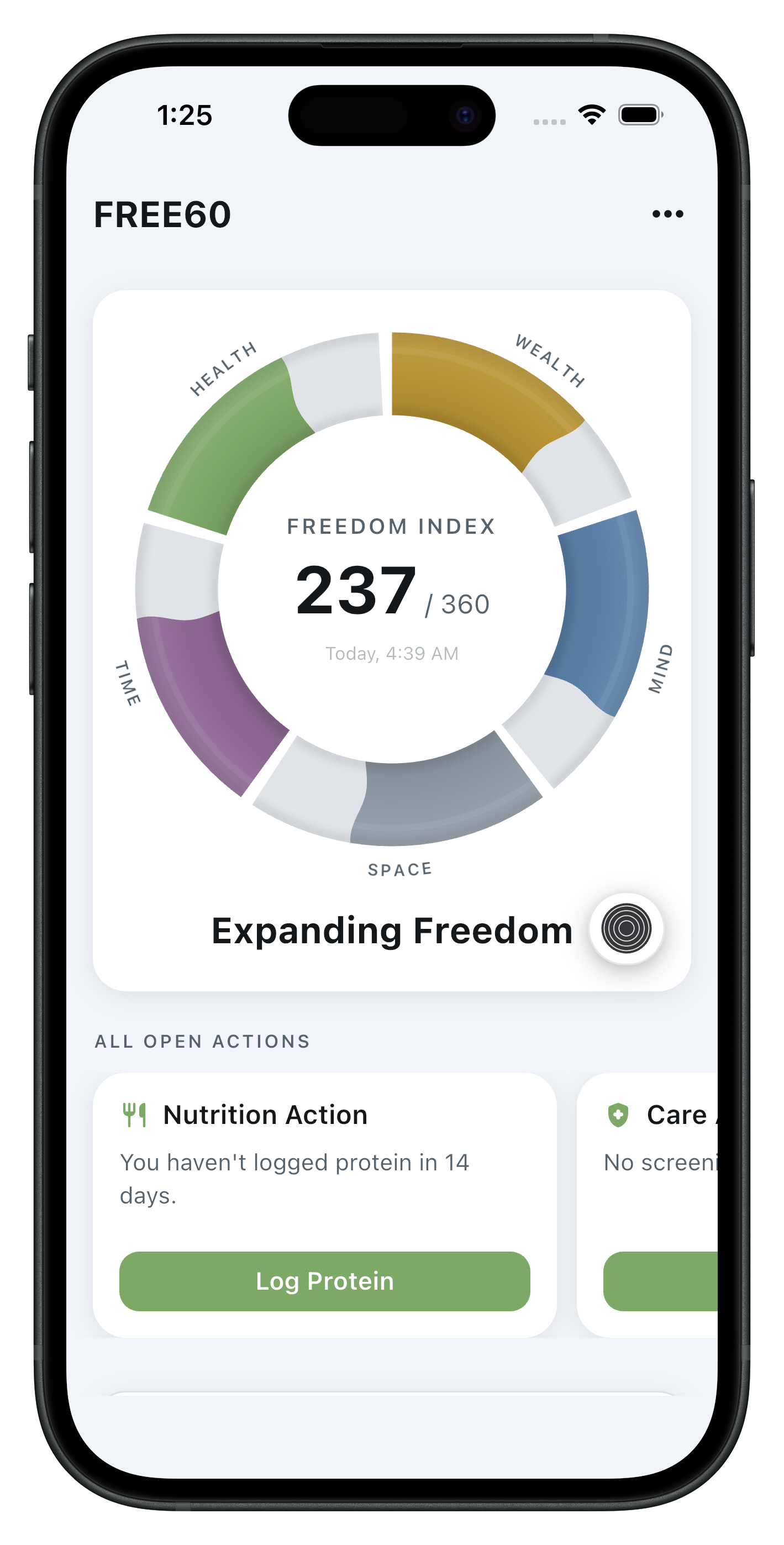
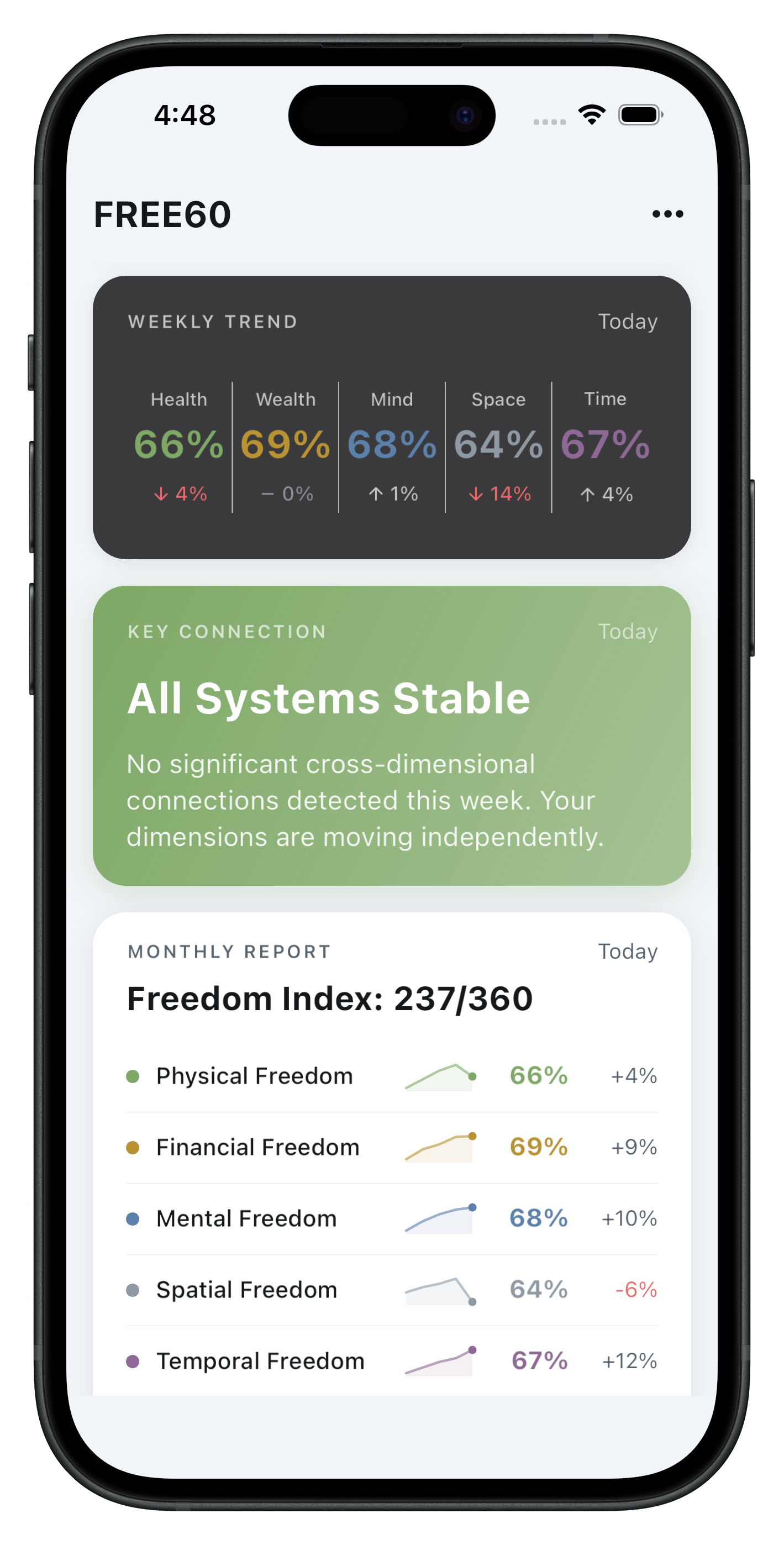
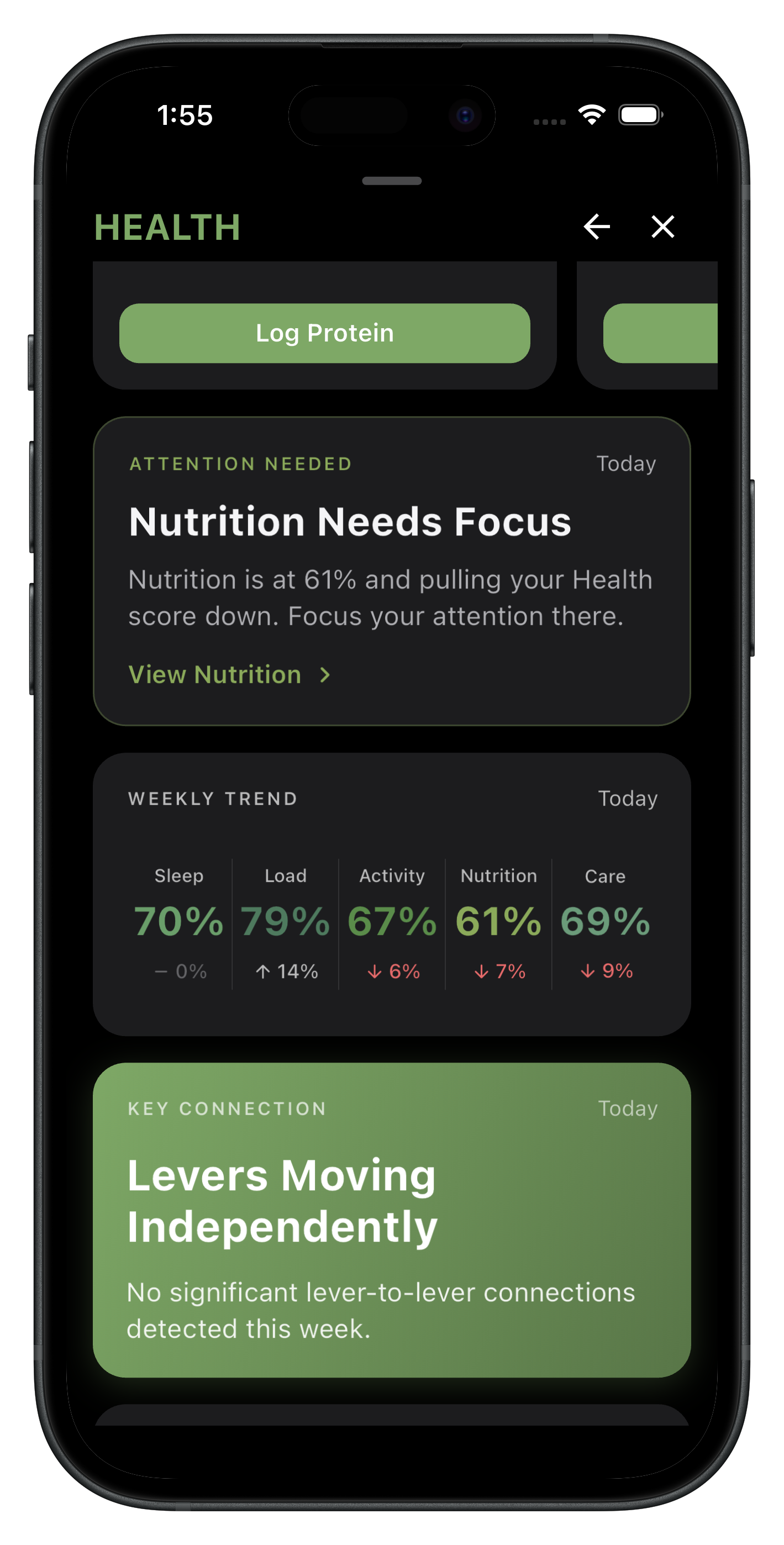
Ready to run the diagnostic on your own system?
Get Notified at LaunchUnder the hood
Every indicator in the system has to earn its score. Here's how the math works.
Every target in the system is derived from either published research or your own biometric profile. Your protein target comes from your weight. Your activity target comes from WHO guidelines. Where research sets the bar, the system uses it. Where it doesn't, it calibrates to your own baseline.
Scores are weighted by recency, consistency, and trend. Recent data matters more than old data. Irregular patterns score lower than steady ones. A score that was strong last month but has been quietly slipping won't still show green. Drift surfaces before it becomes a problem.
The rigor
Every lever, indicator, and signal in FREE60 exists because it was rigorously tested before earning its place.* If a measure fails any single test, it is permanently excluded. No exceptions.
Must detect a failure no other measure already detects. Redundancy is eliminated.
Must be automated or require low-effort input. Obsessive logging is disqualified.
Failure must cascade into at least one other dimension. Isolated metrics are excluded.
Improvement must be visible within 1 to 4 weeks. Lagging indicators are disqualified.
The indicator must detect without requiring ongoing prescriptive behavior. If tracking it depends on daily instructions, it's disqualified.
The goal is system reliability, not metric richness. If an indicator feels "nice to have," it is removed.
* Example: Nutrition lever measures protein adequacy, not calorie intake. Calorie counting fails Test 2 (requires obsessive logging) and Test 5 (the metric itself demands prescriptive behavior to function). Protein adequacy passes all five.
The builder
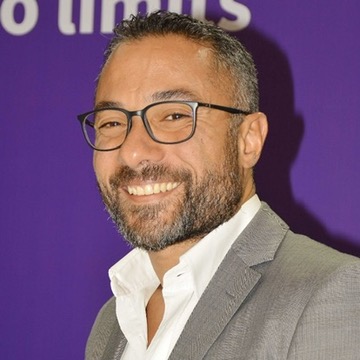
Mohamed Nada is a senior leader at a global healthcare company.
He is the person this app is for: operational, data-literate, responsible for complex systems and aware when performance begins to drift without a clear cause.
He built FREE60 because no tool existed that could see the structure as a whole.
Not a wellness app.
Not a habit tracker.
A diagnostic system built by someone who runs systems for a living.
The ecosystem
The framework behind the scores. Why systems fail quietly and how to read the signals.
Read the book →Structural scoring and the in-app operating systems for each dimension, so you see what's failing and manage it in the same place. No separate template pack.
You're hereGuided courses that teach you how to operate the systems, not just measure them.
Learn more →Discussion, questions, and learnings with others using the system. Public, async, no algorithm games.
Join on Reddit →What it's not
FREE60 doesn't aggregate your data and summarize it. It knows what to look for, explains why it matters, and tells you exactly what to investigate next.
Every session generates a personalized feed: what's failing, why the mechanism matters, and what to do about it. Not generic tips. Your data, your actions.
Every indicator passes a 5-point filter. If it fails one test, it is permanently excluded.
Targets come from published research or your own biometric profile. Nothing generic.
No streaks. No motivational pressure. No daily check-ins.
No feature that needs your attention to function.
The name

The exact number of raw inputs tracked across the system. Each one chosen because removing it would leave a blind spot.
A full circle. Three dimensions read as a single number. Say FREE60 out loud. That's not a coincidence.
The flipped E is a shift in view. When you see the structure that shapes freedom, it comes into full 360° view.
Freedom in this framework is not a feeling. It is a structural condition. You either have it, or something is quietly removing it.
Common questions
You never see 60 things at once. The Freedom Index is one number. Tap into any dimension, lever, or KPI to see the signals beneath it — specific named observations like Sleep Debt, Breach Count, or Income Trend. You go as deep as you want.
You do not log 60 things. A signal is a named observation that FREE60 surfaces from your data. Most come from Apple Health, Health Connect, or your calendar automatically. A small number require a few minutes of input per month.
iOS and Android. Health data pulls from Apple Health (iOS) or Health Connect (Android). Works with any wearable that syncs to either platform.
Health is free, permanently. Wealth and Capacity require Pro: $12.99/month or $99/year. 7-day free trial available.
No motivational coaching. No streaks. No prescriptive routines. FREE60 diagnoses what's failing, explains why it matters, and gives you specific actions based on your data. It guides without telling you how to live.
FREE60 launches June 17, 2026. iOS and Android. Health is free. Leave your email to get notified.
The people this is built for already suspect something is off. This confirms it, or rules it out.
Your data lives on your device. FREE60 does not access, store, or transmit it.
Your email is used only for the waitlist. Never sold, never shared.
Sign in with Apple, Google, or email. Your account is yours. No third-party data sharing.